

The Story Behind the Pasta, the Fork — and the Spoon
By Tami Lancut Leibovitz | Master of Manners
Some foods are simply eaten. Others arrive at the table carrying an entire culture with them. Spaghetti definitely belongs to the second group.
A plate of pasta, a good sauce and a fork — it sounds simple enough. Until the questions begin: Should you use a spoon as well? Is it acceptable to cut spaghetti? Where exactly should you twirl it? And what do you do when one stubborn strand refuses to cooperate on its way to your mouth?
To understand how spaghetti is traditionally eaten, it helps to understand how it became one of Italy’s great cultural symbols.
Did the Italians Actually Invent Pasta?
The answer is more interesting than a simple yes or no.
Foods made from flour and water, in forms resembling noodles or sheets of dough, existed in several ancient cultures. It is therefore difficult to point to one person or one country and say: this is where pasta was invented.
And what about the famous story that Marco Polo brought pasta back to Italy from China?
Mostly a myth.
Forms of pasta were already known in Italy before Marco Polo returned from Asia.
One important historical reference comes from Sicily. In 1154, the Arab geographer al-Idrisi described the large-scale production of itriyya — a form of long, dried pasta — near Palermo, noting that it was exported to other parts of the Mediterranean.
Drying pasta was a major development. It meant that pasta could be stored, transported and cooked whenever needed.
And from there, Italy’s long love affair with pasta continued to grow.
Why Did Pasta Become So Deeply Italian?
The Italians may not have been the only people to combine flour and water, but they transformed pasta into an entire culinary language.
Over the centuries, different regions of Italy developed their own shapes, recipes and sauces. The relationship between the shape of the pasta and the sauce became almost an art form.
Spaghetti, linguine, fettuccine, tagliatelle, penne, rigatoni, orecchiette, farfalle, fusilli — these are not simply different names for the same food.
A ridged pasta may hold a thick sauce beautifully. A long, fine pasta works differently with olive oil, seafood or a delicate sauce. Small pasta shapes may be designed specifically for soups and broths.
Even the tomato — today almost inseparable from our image of Italian pasta — entered the story relatively late. By the nineteenth century, pasta with tomato sauce was becoming firmly established in Italian cooking.
And in Naples, long pasta such as spaghetti became a particularly beloved everyday food.
Pasta Even Helped Change the Fork
Here is one of my favourite details.
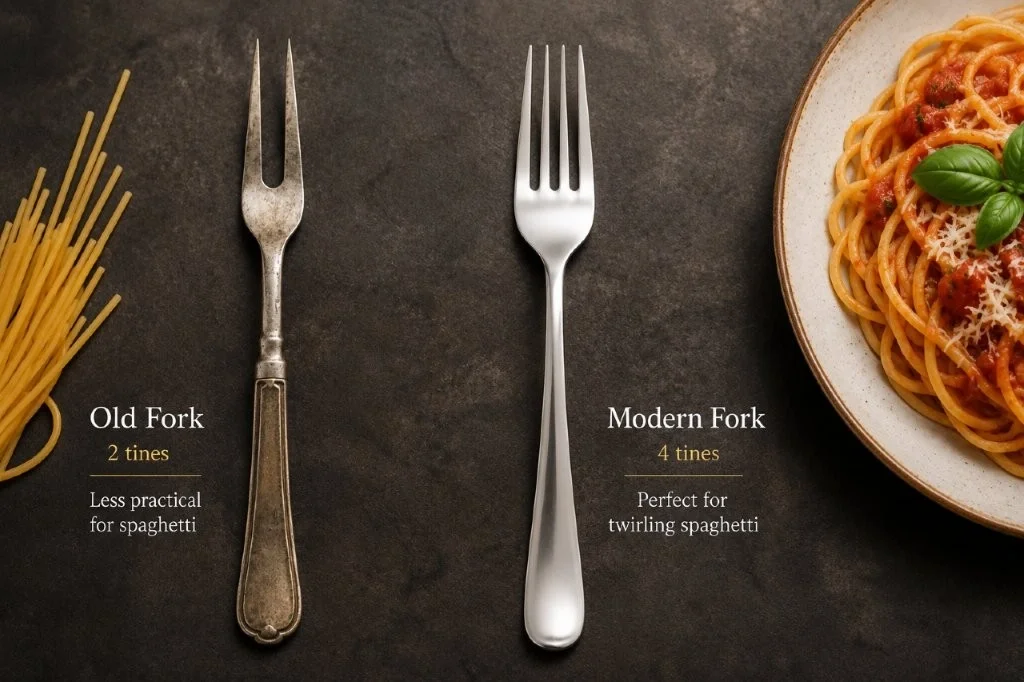
Earlier forks often had two or three tines and were not especially convenient for eating long pasta. By the late eighteenth century, the four-tined fork became increasingly useful in Naples because it made twirling macaroni and other long pasta much easier and more elegant.
In other words, Italians did not only match sauces to pasta.
They even helped adapt the cutlery to it.
Then Spaghetti Crossed the Atlantic
Between the late nineteenth and early twentieth centuries, millions of Italians emigrated to the United States, many of them from southern Italy.
They brought their food traditions with them.
In America, however, those traditions began to evolve.
Ingredients were different. Meat was often more affordable. Portions became larger. Tomato sauces became richer and more abundant, and new Italian-American dishes developed.
The classic example is spaghetti and meatballs.
Italy certainly has spaghetti, and it certainly has polpette — meatballs. But the enormous plate of spaghetti covered in tomato sauce and topped with large meatballs is largely an Italian-American creation rather than a traditional Italian dish.
And so spaghetti moved from regional Italian kitchens to become one of the most internationally recognised foods in the world.
So, How Should You Eat Spaghetti?
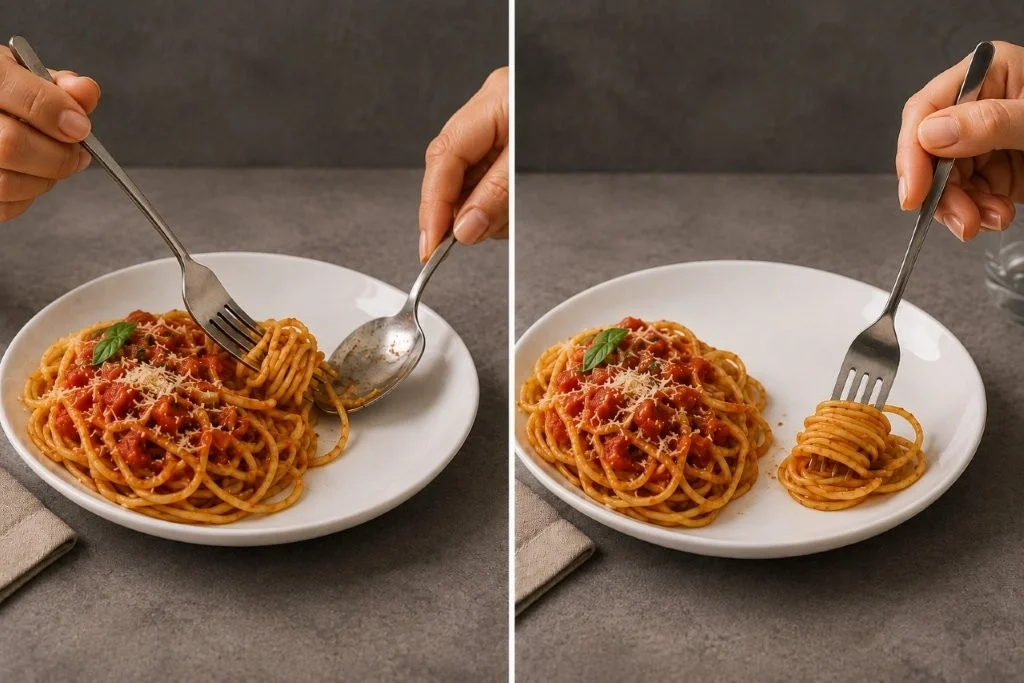
In the traditional Italian manner, the answer is wonderfully simple:
With a fork.
You do not need a knife, and you generally do not need a spoon.
Pick up a small amount of spaghetti with the tips of the fork and move it toward a relatively clear area of the plate.
Then twirl the fork gently against the plate.
Not in the air.
Not at eye level.
And certainly not while attempting to capture half the plate in one heroic rotation.
The goal is to create a small, neat bundle around the fork — one that can comfortably be eaten in a single bite.
If you lift the fork and a large amount of spaghetti is still trailing behind it, you have simply taken too much.
Put it back and try again.
No drama required.
And What About the Spoon?
This is probably one of the questions I am asked most often.
In many countries outside Italy, people have developed the habit of holding a fork in one hand and a spoon in the other, using the spoon as a surface against which to twirl the spaghetti.
Can spaghetti be eaten that way?
Of course.
Is it the traditional Italian way to eat spaghetti?
Generally, no.
A skilled Italian diner uses the plate itself as the surface for twirling the fork.
So if you want to follow classic Italian table practice, leave the spoon aside.
Then Why Are a Fork and Spoon Sometimes Served Together?
Because restaurants around the world adapt to the habits of their guests.
Many diners are accustomed to using a spoon with spaghetti, so some restaurants provide one simply for convenience. Its presence does not necessarily mean that it is part of traditional Italian spaghetti etiquette.
And remember: if several courses are being served, a spoon at your place setting may be intended for soup or another dish.
There is also no need to correct the person sitting beside you if they choose to use a spoon.
Good manners are not a competition to see who can appear “more Italian.”
We are learning a tradition — not joining the pasta police.
Italians Do Use Spoons With Pasta — Sometimes
Absolutely.
When the dish itself requires a spoon, a spoon is entirely appropriate.
Small pasta shapes served in broth or soup are naturally eaten with a spoon. Examples include:
Pastina in brodo — tiny pasta served in broth;
Minestrone containing small pasta;
Pasta e fagioli, especially when prepared in a more soup-like style;
and tortellini or cappelletti in brodo, served in broth.
So the accurate rule is not:
“Italians never eat pasta with a spoon.”
It is:
A spoon is appropriate for soup or pasta served in broth — not traditionally as a tool for twirling spaghetti.
And What Should You Avoid?
Do not cut spaghetti with a knife.
Long pasta is intended to remain long. Young children, people with limited mobility or anyone with a medical need are, of course, a different matter. Etiquette should never take priority over comfort or safety.
Do not slurp spaghetti noisily.
A practice that may be perfectly acceptable with noodles in some cultures is not part of traditional Italian-European table manners.
Do not lift the fork high into the air to search for the end of the spaghetti.
Keep the movement close to the plate.
And do not load so much pasta onto the fork that you have to negotiate with it once it reaches your mouth.
The solution to almost every spaghetti problem is remarkably simple:
Take less.
Your posture matters too.
Bring the fork toward your mouth rather than lowering your face toward the plate. A slight natural inclination forward is perfectly normal, but there is no need to chase your spaghetti around the table.
The Most Important Rule? Don’t Turn Pasta Into an Exam
Table manners are not meant to make us nervous.
They are not there so that we spend an entire meal wondering whether we are holding the fork at the correct angle or whether someone at the next table is judging our technique.
Quite the opposite.
Good dining manners exist to make eating more comfortable, cleaner and more pleasant — for us and for the people sharing the table.
Once the movement is learned, it becomes natural.
A little spaghetti.
A fork.
A small twirl against the plate.
One comfortable bite.
And the conversation continues.
Because ultimately, the most elegant way to eat spaghetti is not to fight with it.
We manage the spaghetti — we do not let the spaghetti manage us.
©All tights reserved to Tami Lancut Leibovitz


Comments
Add a comment
Your email will not be published. The comment appears after approval. * Required field